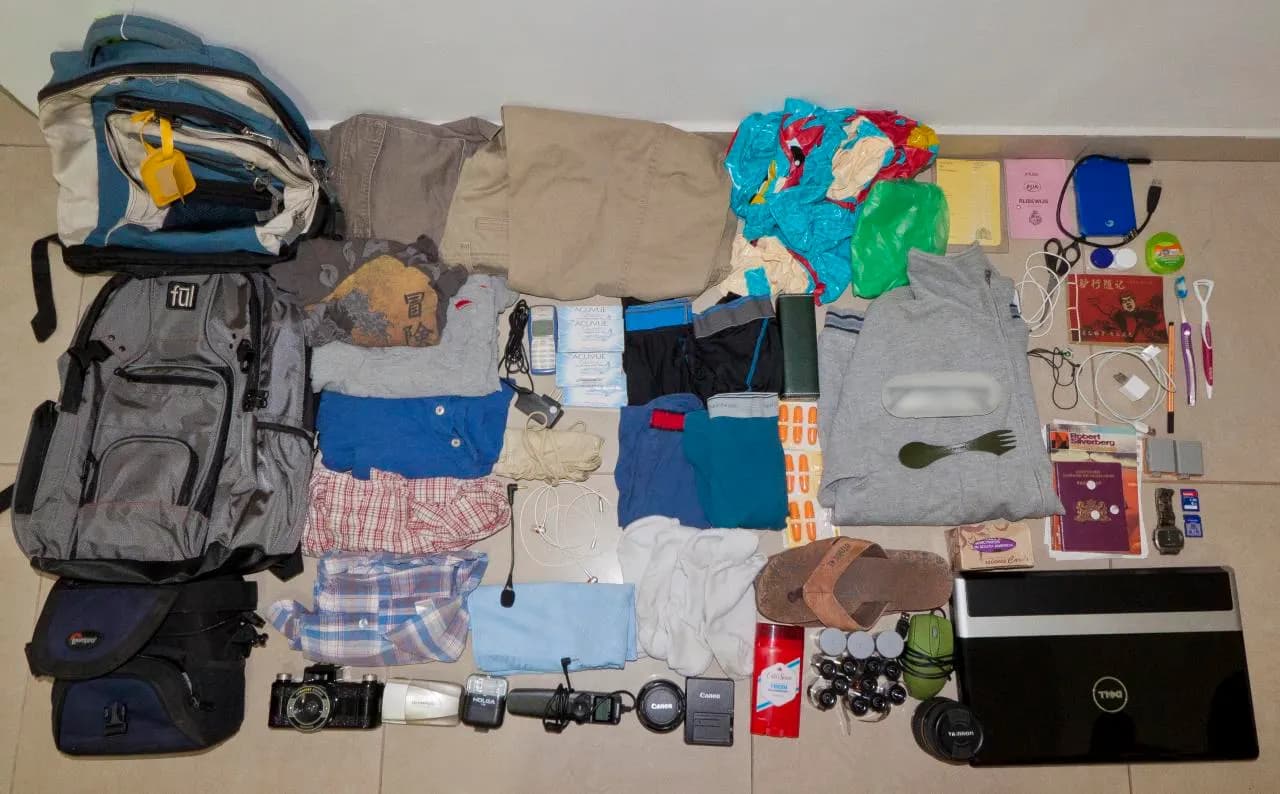
Workation packing lists often read as if an entire office were emigrating. The opposite is true: almost everything you need for four weeks of working abroad fits into a backpack, as long as you know why you're taking it. That's why every item here comes with a reason. Anything without one stays at home.
Tech: redundancy only where a failure costs you days
A laptop plus a second device you can work on in an emergency. Usually that's a tablet or a smartphone with a keyboard. A broken laptop in Tbilisi means three to ten days of repairs, or buying a new one at prices above German levels. You don't need to be productive during that time, but you do need to be reachable.
Two ways to get online. The Wi-Fi at your accommodation and a local SIM or eSIM with at least 20 GB. That's not a backup, that's the normal case: in Southern Europe the Wi-Fi in old buildings drops out regularly, and in Southeast Asia mobile data is often faster than the apartment's connection. A travel router only pays off from eight weeks onwards.
Noise-cancelling headphones with a microphone the other person can actually understand. Cafés, colivings and flex desks are loud. The point is less that you hear better and more that your team doesn't file you away as "the one with the street noise".
A charger with several ports (65 W or more) and a grounded travel adapter. One power supply for everything halves the cable mess. The grounded adapter matters more than it sounds: many cheap adapters have no earth connection, and then laptop power supplies make the casing tingle.
No second monitor. A 15-inch travel monitor weighs a kilo and needs space on a desk that your accommodation often doesn't have. If you really need two screens, rent a fixed desk with a monitor in a coworking space. That's cheaper than the weight.
Ergonomics: the part everyone cuts and regrets after two weeks
A foldable laptop stand and a compact external keyboard. Together under 500 grams. A laptop at table height forces your head 30 degrees down, and after ten days your neck hurts. This is the piece of kit almost everyone only takes on their second workation.
A mouse, if you work with spreadsheets or design. Otherwise not.
What you don't need: the ergonomic chair. You'll find one in the coworking space. Accommodation with a "workspace" often has a kitchen chair, so ask for a photo before booking.
Documents: paper in case your phone doesn't work
- Your passport, even within the EU. Legally, a German ID card is enough, but car rental companies, some accommodation and a return flight via a non-EU country (changing planes in Istanbul or London) will want the passport.
- Your A1 certificate (proof that you stay covered by German social security) as a PDF and printed out, if you're employed and working in the EU. The printout because inspectors don't want to look at your screen.
- European Health Insurance Card plus your travel health insurance policy, with the emergency number saved offline.
- Written confirmation from your employer that you're allowed to work remotely. Nobody asks for this on entry in Portugal, Spain or Georgia. In Thailand or Indonesia you may be asked about the purpose of your stay, and "holiday" is a thin answer for four weeks with a laptop.
- Two credit cards from different banks and €100 to €200 in cash in the local currency for the first few days. A blocked card abroad is no drama if a second one exists.
Health: what you can't get quickly on the ground
Your regular medication for the whole trip plus two weeks in reserve, with the package leaflet and, for prescription drugs, a copy of the prescription. A lot of it is cheaper abroad, but sold under a different name, and finding it costs half a day. Add a small kit: painkillers, anti-diarrhoea tablets, electrolytes, plasters, a thermometer. Everything else comes from the local pharmacy, which exists everywhere.
For Southeast Asia and Latin America: insect repellent with at least 30 percent DEET bought in Germany, as local products are often weaker. And high-factor sunscreen, which you can get on the Canary Islands, but at twice the price.
What doesn't need to come
The printer, the travel kettle, the second jacket, the third pair of shoes, the power bank over 100 watt-hours (that can't go on a plane without the airline's approval). And the fear of forgetting something: apart from medication, passport and laptop, you can buy everything locally within 24 hours. That's the real reason this list is short.